Position uncertainty and visual search
Visual search, the act of making eye movements to locate an object in an environment, is ubiquitous and a necessary part of everyday life. Visual search requires integration of perceptual information and decision making under uncertainty. One of the fundamental properties of visual search is uncertainty regarding the position of search targets. To successfully complete a search, observers need to integrate information across eye movements while ignoring information from irrelevant positions. This project characterizes position uncertainty in visual search while also quantifying individual observer's ability to detect and localize targets in periphery as a function of visual expertise.
Clutter and search in natural images
Artificial stimuli provide a controlled environment, in which strong predictions about the search performance can easily be made. However, this method provides only limited information on how observers search in more naturalistic contexts. This question is challenging because the number of variables that can be controlled decreases rapidly as the search environments get more naturalistic. For example, in natural scenes, objects appear in various positions and orientations; and they can easily occlude one another. Additionally, the amount of clutter in natural scenes cannot be manipulated as in artificial stimuli. Clutter affects the ability to detect and localize objects in natural images. This project aims at quantifying the effect of clutter on visual searches in naturalistic images.
Texture statistics in mammograms
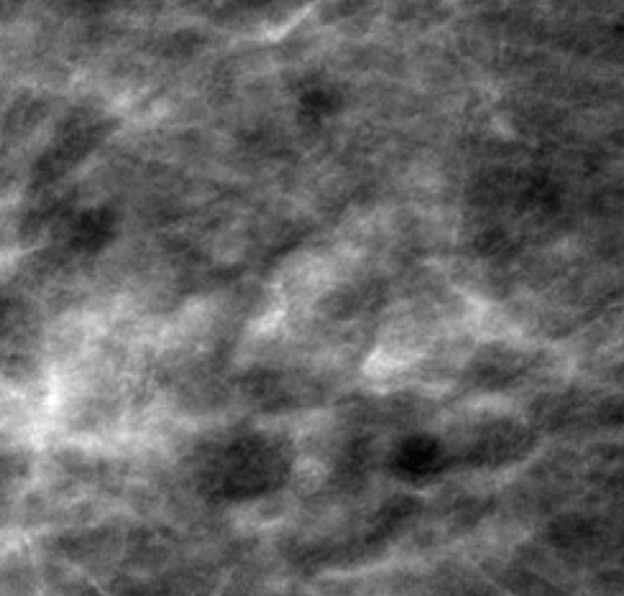
While many computer-assisted systems are available as a tool for radiology professionals to utilize during case-reading, the diagnostic task of inspecting medical images still largely relies on the human visual system, which is inherently limited. To this end, medical image perception research examines the perceptual factors that influence the diagnostic performance of radiologists. Our project examines the performance of radiology experts when discriminating between normal and abnormal breast tissue and seeks to characterize a diagnostic signal using texture analysis. It involves both synthesizing tissue sections (e.g., image on the left) and working with radiology experts.
Modeling peripheral vision in maze perception
Our central vision can only process a certain amount of information at high fidelity, our peripheral vision is limited, and yet we still have a stable sense of the world around us. How does this happen? Our recent work focuses on modeling peripheral vision to understand this fascinating ability. Mental maze solving involves both cognitive and perceptual processes and can provide a controlled environment to study peripheral vision. We are particularly interested in the effect of visual crowding, a well-known limiting factor in peripheral vision, in mental maze solving.
Visual perception in video conferencing
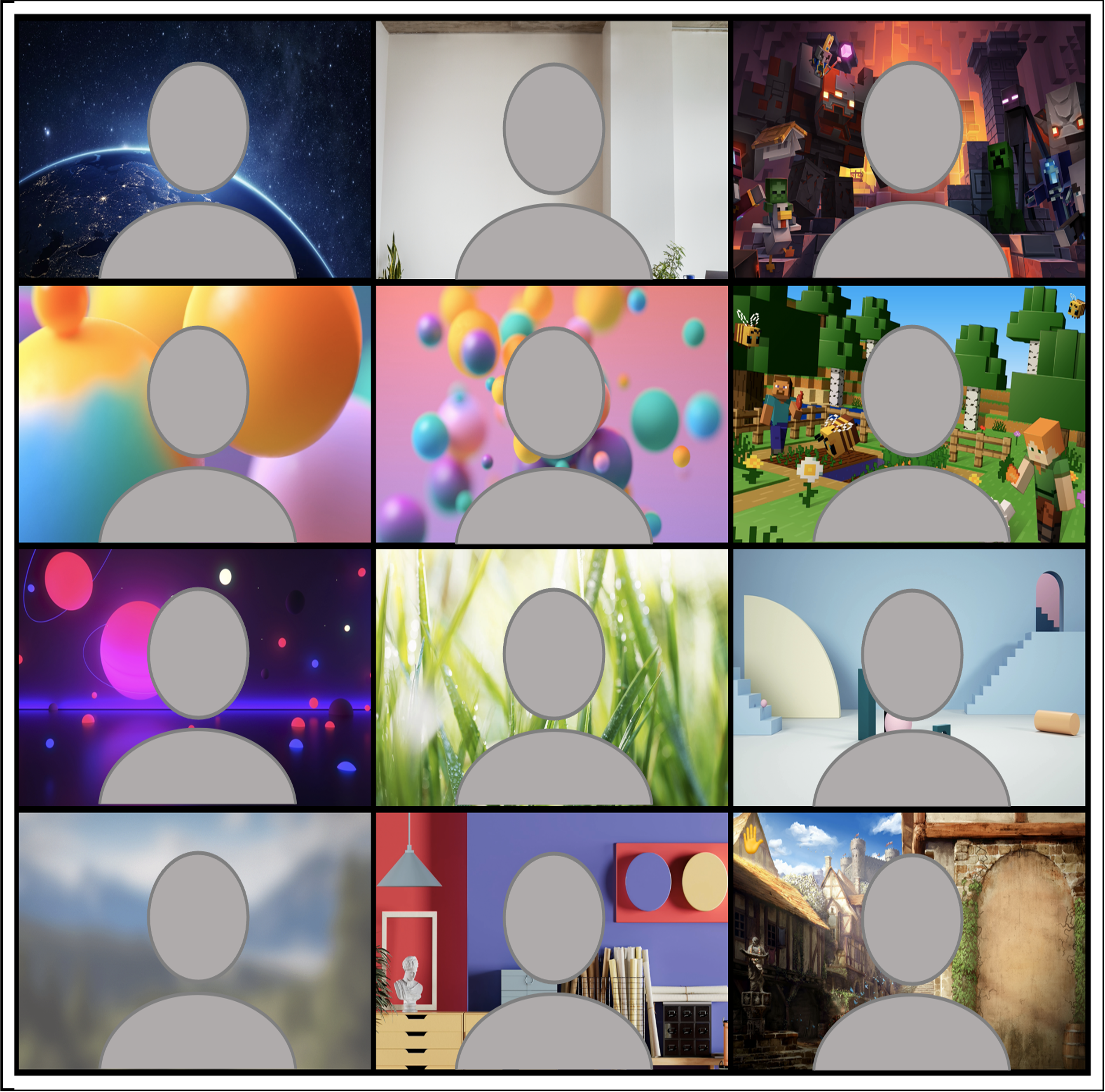
Due to an increase in remote work and communication, the use of video conferencing tools has risen in recent years. This project examines the role of visual perception and attention in video conferencing experience, using behavioral psychophysics, computational modeling, and eye-tracking. Specifically, we aim to answer basic science questions about fundamental processes in human visual perception and attention, while also gaining insight into whether video conferencing tools might be sub-optimally designed from the point of view of those perceptual processes. Can you spot the raised hand symbol in the image?